Archive | December, 2011

I ♥: Flavored Sparkling Water

9 Dec

Swedish tap water is of excellent quality, and many people have carbonator machines at home to make their own sparkling water.  Our Swedish producer explained to me that, in order to stay in business, sparkling water companies (Ramlösa and Loka are the big ones) have developed clever flavor options to keep their products appealing and interesting.  Although there are flavored sparkling waters in the US (sugar-free, all natural, sparkling), the flavor options in Sweden are far more extensive and go beyond the typical lemon/lime variety.  Recently, I found rabarber — rhubarb.  It’s faintly sweet (there’s no sugar in it — it’s more an essence and aroma of rhubarb).  It’s nice, and I like it, although I wonder if the idea of rhubarb sparkling water is what really piques my interest, rather than an actual “taste.”  There’s just something… magical?  Scandinavian?  Cozy?  about a rhubarb-flavored sparkling water.

The other interesting ones I’ve tried are Kaktus (cactus — more like aloe?) and Fläder (elderflower).

Of a more “common” flavor profile, I quite like Vitamin Well Sparkling Water in the Persika flavor — peach.  (Full disclosure: when I bought the Persika Vitamin Well Sparkling Water, I thought it might be PEAR flavor… but upon drinking it, learned that Persika is Swedish for peach.)

I am not sure how much flavored sparkling water Swedes really buy (although there seems to be a big market for it), but I for one  love them!   They are fun and refreshing at the same time, and I look forward to trying a variety of unusual flavors.

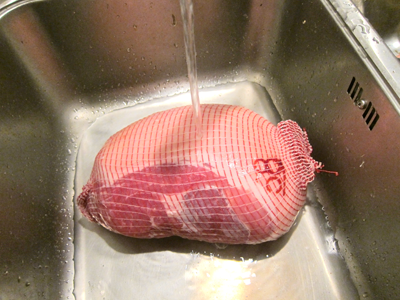
Julskinka (Christmas ham)

9 Dec

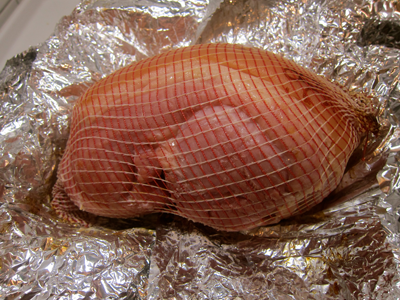
With the Christmas season upon us, the meat section in our local Daglivs is stocked full of Julskinka (Christmas ham).  I have never made a Christmas ham from scratch; actually, David and I have never made roast ham for any of our Christmases together.  But as the Julskinka seems like such the typical Swedish meat for the season, we were both curious to try it… now.  And so we bough a lovely organic, fresh, salt-cured harm looked lovely to cook for a Sunday “roast.”

The Julskinka packaging explains the traditional method of roasting the ham.  Sadly, I could only decipher bits and pieces, not enough fill me with confidence to know what I was doing.  So we took a photo of the instructions on the package and sent it to our Swedish colleague, who kindly translated them for us.  The actual cooking of the ham is quite easy, although it takes a couple of hours.  A cooking thermometer is definitely needed, and I picked up an electronic one at a local hardware store.

Preheat the oven to 175C (or 350F).

Rinse the pork under water — the pork is salted-cured, so it’s important to rinse thoroughly.

Pat dry, and cover in foil.

Place in the lower part of the oven with a cooking thermometer in the meat.  Roast until the internal temperature reads 73-75C (or about 165/167 F).

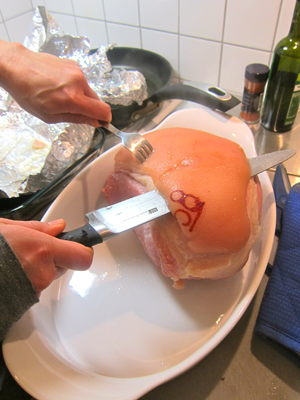
Take the ham out of the oven.  (*Do not turn off the oven, as the ham will go back into it.)  Cut away the netting, and remove the fat.

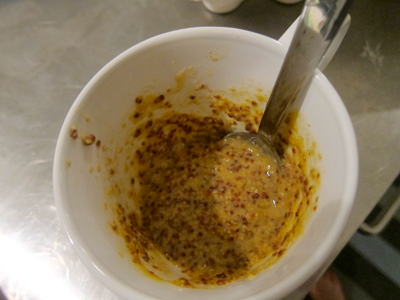
Make the mustard coating: mix one egg yolk and 3 tablespoons of wholegrain mustard.

Cover the ham with the mustard mixture.  Typically, breadcrumbs are added all over the mustard coating — I sprinkled fresh thyme instead.

Raise the oven temperature to 200C (or about 390F).  Put the ham back in the oven and roast until it browns, about 15 minutes.

Rest for 5-10 minutes.  Slice thinly and serve!

For dinner, we had slices of ham alongside some broccoli and mushrooms.  The ham has a salty quality, so it’s good to pair with non-salty vegetables.  Although we bought a “small-ish” Julskinska, it’s still A LOT of ham for 2 people.   But the ham is great cold — in fact our Swedish colleague explains that it is best the day after on some bread with some mustard.  The bread we don’t do, of course, but the ham has served us well, providing us all week as a quick, ready source of protein at home.  Whether for snacks (on its own or with slices of cucumber or avocado) or with scrambled eggs for breakfast, the Julskinka is a nice, holiday meat to try at home.

P.S. The next time I make this, I think I may add some sweetness to the mustard coating by adding honey…

Simple Dishes: Roast Pork Tenderloin w/Garlic-Ginger Rub

3 Dec

Grocery shopping can lead to impulse purchases.  If something looks fresh and beautiful, I find it hard not to want to take it home to cook it, even if I don’t exactly know what to do with it at the time of purchase.  Pork tenderloin was one such purchase.  I’d never cooked pork tenderloin before, but the butcher in Saluhall had fantastic-looking pork tenderloin and I couldn’t resist.  After work, at home, I Googled various pork tenderloin cooking methods.  Many recipes call for 3 hours or overnight marination — I didn’t have the time, since the pork was meant for dinner that night.  So I decided to just rub some spices I had at home and roast it.  Although I’m sure marinating the tenderloin overnight will infuse it with flavor and tenderize the meat, I think this simple spice rub worked quite nicely.

SPICY ROAST PORK TENDERLOIN WITH GARLIC-GINGER RUB

  • 3 tsp garlic powder
  • 3 tsp ground ginger
  • 1 tsp cayenne pepper
  • 1 teaspoon ground cumin
  • Salt
  • 1 1/4 pounds pork tenderloin
  • Olive oil
  • 3 garlic cloves, minced

Preheat the oven to 450F.

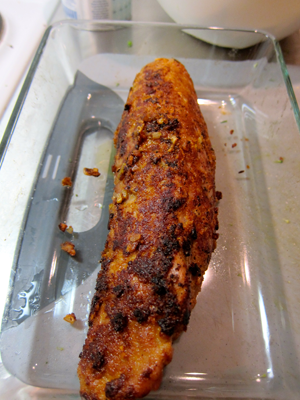
In a small bowl, mixed garlic powder, ground ginger, cayenne pepper, and salt.  Stir well with a fork to combine — this will be the rub.  With dry hands, sprinkle the tenderloin with the rub, making sure to cover the entire tenderloin.  Gently pat the rub to ensure that that the seasoning adheres to the tenderloin.

In a large skillet or pan over medium-high heat, add olive oil (about 1 tablespoon).  Add the minced garlic and saute, stirring, for about 1 minute.  Put tenderloin in the pan and cook for about 10 minutes, searing each side and turning the meat.

Transfer meat to a roasting pan and bake for 20 minutes.

Rest for 5 minutes.  Slice and serve!